- July 21, 2026
Family History of Cancer? Know Your Risk Before It's Too Late
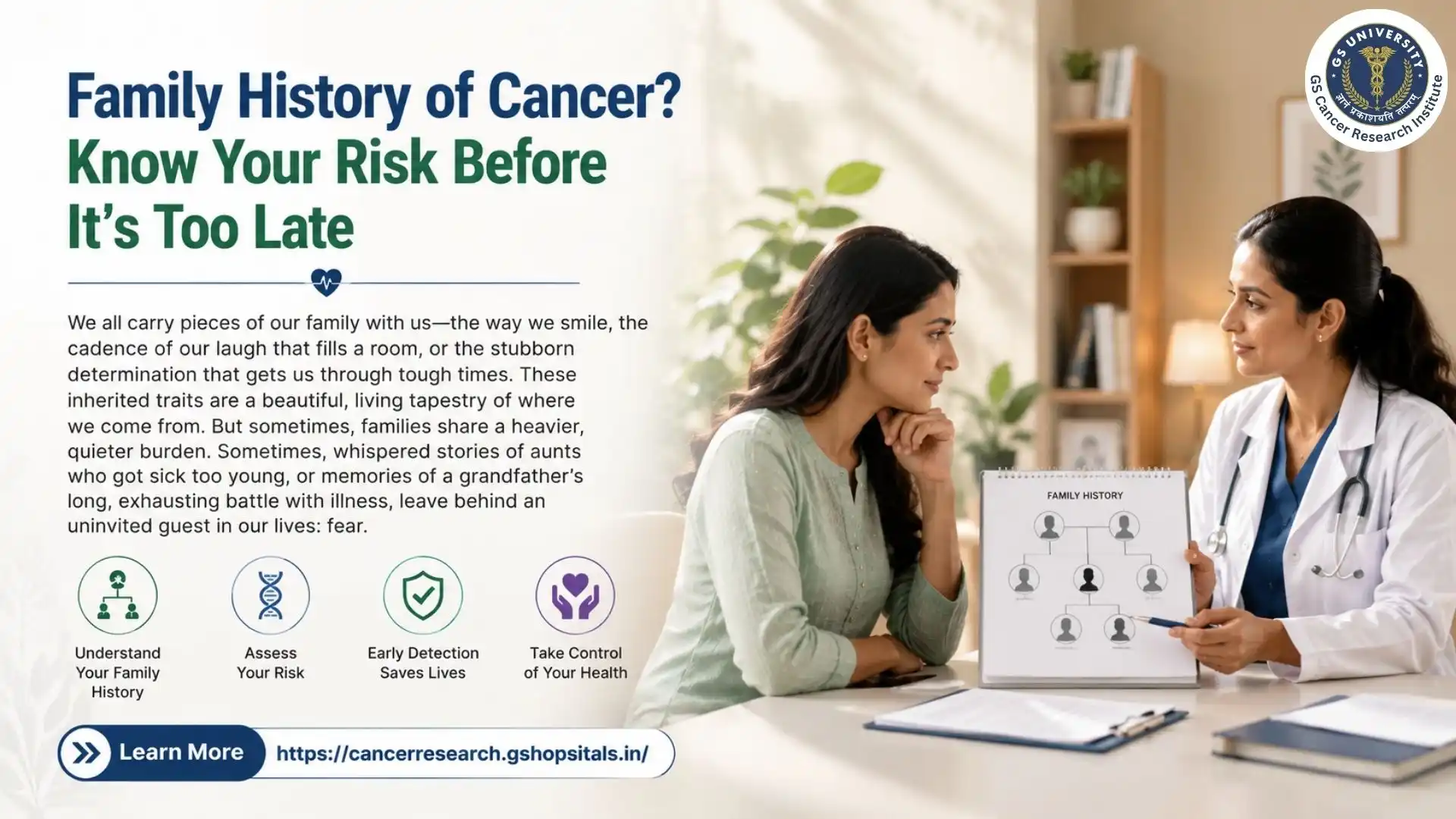
We all carry pieces of our family with us—the way we smile, the cadence of our laugh that fills a room, or the stubborn determination that gets us through tough times. These inherited traits are a beautiful, living tapestry of where we come from. But sometimes, families share a heavier, quieter burden. Sometimes, whispered stories of aunts who got sick too young, or memories of a grandfather's long, exhausting battle with illness, leave behind an uninvited guest in our lives: fear.
If you live with a prominent Family History of Cancer, that fear can sit quietly in the back of your mind, casting a shadow over your future milestones. Every unexplained ache, every routine medical checkup, or every milestone birthday brings a lingering, anxious question: Is it my turn next?
Let's talk honestly about what a family history really means, the profound emotional weight it carries, and how local medical landmarks like the GS Super Speciality Hospital and the GS Cancer Research Institute are helping families transform inherited fear into proactive, lifesaving empowerment.
The Weight of the Unspoken: When Cancer Runs in the Family
There is a unique emotional landscape that comes with watching a loved one fight a terminal or severe illness. If you have witnessed a parent, sibling, or extended family member go through aggressive treatments, the word “cancer” isn't just a clinical term you read in a medical journal. It is a sensory, deeply painful memory.
When multiple generations of family members have faced this diagnosis, an unspoken anxiety can weave its way into the very fabric of your family dynamic. The biggest mistake we can make when dealing with this immense emotional weight is turning to avoidance. Acknowledging your risk isn't an admission of defeat or an acceptance that you are bound to get sick—it is the very first step toward fierce self-preservation and protecting the people who count on you every single day.
De-Coding the Biology: What Does Hereditary Risk Actually Mean?
To break free from the paralyzing grip of anxiety, we have to pull back the curtain and look closely at what we are actually dealing with from a biological standpoint. A very common misconception is that if your relative had cancer, you are automatically destined to face it too. This is simply not true. The human body is incredibly complex, and not all cancers are passed down through generations. In fact, the vast majority of cancer diagnoses worldwide are “sporadic,” meaning they happen due to random genetic mutations over a lifetime, natural aging, environmental exposures, or lifestyle choices.
However, roughly 5% to 10% of all cancer cases are classified as truly hereditary. This means a person is born with an altered gene or a specific genetic mutation passed down from either their mother or father that significantly increases their susceptibility to developing certain types of tumors. This is what medical science refers to as the Genetic Risk of Cancer.
When an experienced Oncology Specialist looks at a patient's background, they don't just look at a single diagnosis. They look for specific red flags across your lineage that separate ordinary, sporadic occurrences from a deeply embedded hereditary pattern. These critical signs include:
Early Onset of Disease
Most cancers are diseases of aging, typically appearing later in life. When breast, ovarian, colon, or uterine cancer is diagnosed in individuals who are unusually young—such as in their 20s, 30s, or 40s—it strongly suggests that an inherited genetic factor bypassed the normal timeline of cellular aging.
Multiple Affected Relatives
A single case of cancer in a family tree is common. However, when multiple close relatives on the exact same side of the family (either all maternal or all paternal) develop the same type of cancer, or a cluster of biologically related cancers (such as breast and ovarian cancer, or colon and endometrial cancer), it indicates a shared genetic thread.
The Presence of Multiple Primary Tumors
If a single relative has been diagnosed with two or more entirely different types of cancer over their lifetime—for instance, developing a distinct colon cancer and later a distinct stomach cancer, rather than one spreading to the other—it indicates that their cellular defense mechanisms have an inherited vulnerability to developing malignancies.
Rare or Uncommon Cancers
When rare forms appear within a family tree—such as male breast cancer, specialized neuroendocrine tumors, or specific childhood soft tissue sarcomas—it is a clear indicator that a thorough genetic evaluation is required.
Understanding this biological breakdown is incredibly liberating. Finding out you have a genetic predisposition does not mean you are guaranteed to fall ill. It simply means you have been handed a map of where your physical vulnerabilities lie. It gives you the rare, invaluable opportunity to fortify your defenses and build a protective wall around your health before a battle even has a chance to begin.
The Power of Knowing: Moving from Fear to Action
Early detection completely changes the rules of the game. When a potential cellular abnormality is caught in its earliest, pre-cancerous, or localized stages, the treatment options are dramatically gentler, less invasive, less financially devastating, and radically more successful. Instead of reacting to a full-blown health crisis in an emergency room, you and your medical team can manage your health proactively on your own terms.
For those with a verified high-risk profile, screening doesn't mean waiting for symptoms to appear. It might mean starting routine mammograms or colonoscopies a decade or more earlier than the general public.
Finding The Right Hospital
When you finally make the courageous decision to confront your family risk, the environment where you seek care matters immensely. This isn't just a standard physical checkup or a simple blood draw; it is a deeply personal, emotionally charged journey that touches on your deepest vulnerabilities. You need far more than just advanced machines and cold, clinical results; you need an ecosystem built on empathy, deep expertise, and comprehensive, continuous care.
For residents living in and around the Western Uttar Pradesh region, accessing world-class oncology expertise no longer requires undergoing long, exhausting, and expensive journeys to distant metropolitan hubs. Recognized widely across the region as the Best Hospital in Hapur, GS Super Speciality Hospital has established a dedicated sanctuary for preventative oncology and genetic risk assessment.
Through its highly specialized GS Cancer Research Institute, individuals can walk into a medical space designed specifically to address both the highly technical clinical dimensions and the fragile emotional realities of cancer care. Choosing a dedicated Cancer Screening Hospital means finding an institution that refuses to treat you like a number on a clipboard, offering instead an end-to-end continuum of care built on three foundational pillars:
Compassionate Genetic Counseling
Before any blood is drawn, a specialized team works closely with you to map out your lineage, deciphering historical patterns and helping you understand your true statistical risk without causing unnecessary panic.
High-Precision Diagnostics
Utilizing the absolute latest in diagnostic imaging, genetic testing panels, and specialized tumor biomarkers, the institute is capable of catching microscopic cellular changes long before physical symptoms ever manifest in your body.
A Multidisciplinary Expert Panel
Your health path isn't determined by a single doctor. Instead, a collaborative panel of oncology specialists, radiologists, and genetic experts come together to build a personalized, long-term surveillance roadmap tailored exclusively to your unique biological footprint.
The GS Cancer Research Institute Advantage
[Step 1: Counseling] ➤ Mapping your 3-generation family tree
[Step 2: Diagnostics] ➤ Utilizing advanced genetic panels
[Step 3: Roadmap] ➤ Creating a lifetime care protocol
Walking through the doors of the Best Hospital for Cancer Screening shouldn't feel like walking toward a dark diagnosis. It should feel like stepping into a protective, empowering shield—an act of profound self-care, a relief from anxiety, and a beautiful declaration of love for your family's collective future.
Writing a New Legacy for the Generations to Come
It is incredibly easy to look at a dense family history of severe illness and feel a profound sense of genetic betrayal, as if your own body is a ticking time bomb inherited from those you love. But there is another, much more powerful way to look at this situation. Your family's painful history has given you a priceless, early warning system that others simply do not have.
The generations that came before you did not have access to the rapid technology, the advanced genetic research, or the highly specialized medical institutes that we have at our fingertips today. They fought their health battles blindly, with whatever limited tools they had at the time, often discovering their illnesses far too late. They endured those hardships so that we could have the chance to live differently.
By utilizing modern medicine to deeply understand and map your risk today, you are truly honoring their struggles. You are taking the raw pain, grief, and loss of the past and converting it into lifesaving wisdom and protection for the future. You are ensuring that the ongoing story of cancer in your family tree stops being a cyclical tragedy of unexpected loss, and instead transforms forever into a legacy of resilience, profound awareness, and medical triumph.
Do not let fear dictate the timeline, the joy, or the peace of your life. Reach out to an Oncology Specialist, map out your family history, and take definitive control of your health. It is an act of immense courage that your future self—and the family wrapping around you—will thank you for across all the years to come.
Frequently Asked Questions (FAQs)
1. Does a family history of cancer mean I am guaranteed to develop it?
No, absolutely not. Having a family history or carrying a specific genetic mutation simply means that your baseline statistical risk of developing certain types of cancer is higher than that of the general public. It represents a predisposition or an increased vulnerability, not a final medical diagnosis. A vast number of individuals who carry a strong family history live long, vibrant, and completely healthy lives without ever developing the disease, especially when they utilize consistent, proactive medical surveillance and healthy lifestyle choices.
2. At what age should I begin undergoing cancer screenings if it runs in my family?
As a general medical guideline, high-risk screening protocols often begin roughly 5 to 10 years earlier than the youngest age of diagnosis in your immediate family line, or starting between the ages of 25 and 30 for certain aggressive hereditary conditions. However, because every family tree is biologically unique, there is no single one-size-fits-all answer. You should schedule a consultation with a qualified Oncology Specialist who will evaluate your specific lineage and build a customized screening timeline for you.
3. What actually happens during a professional genetic risk assessment?
A genetic risk assessment is not a painful medical procedure; it is primarily a detailed, compassionate conversation. A specialist will sit down with you to thoroughly review your medical history and construct a comprehensive, three-generation family tree. If a strong hereditary pattern is identified, they may recommend a highly precise, non-invasive blood or saliva test to look for specific inherited gene mutations (such as BRCA1 or BRCA2). This testing is always accompanied by psychological and emotional guidance to help you understand the results.
4. Are lifestyle changes effective if I already know I have a high genetic risk?
Yes, lifestyle modifications remain incredibly powerful, acting as your daily shield. While you cannot alter the fundamental DNA sequence you were born with, healthy choices—such as maintaining an active lifestyle, eating a balanced diet rich in antioxidants, avoiding tobacco entirely, and limiting alcohol intake—can directly influence your body's cellular environment and how your genes express themselves over time. A clean, healthy lifestyle works hand-in-hand with clinical screening to significantly lower your overall risk profile.
5. Why should I choose a specialized institute like the GS Cancer Research Institute over a regular clinic?
While general healthcare clinics can run standard, routine blood tests, a dedicated center like the GS Cancer Research Institute provides a highly concentrated ecosystem of oncology experts, cutting-edge diagnostic imaging technology, and deeply specialized screening programs. This high degree of specialization ensures that subtle cellular variations are accurately interpreted, saving you from a lifetime of unnecessary anxiety while providing a definitive, compassionate, and actionable plan to safeguard your life.